Introduction: More Than a Meal
Your grandmother didn’t just cook Eru soup. She performed a ritual. Every leaf she picked, every piece of meat she selected, every hour she spent stirring over a fire—it was all an act of cultural preservation.
When she made Eru soup, she was saying something without words: My people matter. Our ways matter. This food—this particular combination of leafy greens, palm oil, and spices—is proof that we existed long before anyone wrote our history down.
Eru soup isn’t just comfort food. It’s not just nutrition. It’s a statement of identity that travelled with diaspora families across oceans and stayed unchanged for generations. Your mother made it the same way her mother made it. And somewhere in diaspora communities across the UK, Europe, and beyond, Manyu women are still making it the exact same way—because changing it would mean losing something irreplaceable.
Yet here’s what’s happening: fewer diaspora children know how to make Eru soup. Fewer understand why it matters. Fewer recognise that in that single pot of green leaves and rich palm oil is encoded centuries of Manyu agricultural knowledge, healing wisdom, and cultural resilience.
This is the story of Eru soup—the science behind why it nourished your ancestors, and the soul of why it still defines who you are.
What Is Eru Soup? The Foundation of Manyu Culture
The Name, The Plant, The Significance
Eru is the Ejagham word for a specific leafy green—Gnetum africanum, known by various names across Africa: afang in Igbo communities, okazi in Yoruba regions, poudrette in French-speaking areas, and simply wild spinach or African spinach to those unfamiliar with its cultural weight.
But calling Eru soup “spinach soup” is like calling a wedding ceremony “a meeting with someone.” Technically accurate. Entirely missing the point.
When you make Eru soup, you’re not just combining ingredients. You’re participating in a culinary tradition that goes back centuries. You’re using the same basic method your great-grandmothers used. You’re honouring the women who kept this knowledge alive through colonisation, through migration, through the systematic erasure of African foodways.
Eru isn’t cultivated in vast industrial farms. It grows wild in the forests of Cameroon and Nigeria—particularly abundant in Manyu Division. It was never domesticated in the way wheat or rice were. It remained wild, which means it remained theirs. No colonial power could patent it. No agricultural company could monopolise it. The knowledge of how to harvest it, how to prepare it, how to transform it into a dish that fed communities—that knowledge lived in the hands and the memories of Manyu women.
That’s why Eru soup matters. It’s not romanticising to say this is decolonial food. It is. Every time you make it, you’re choosing to centre African knowledge, African ingredients, African taste, African ways of nourishing community.
The Culinary Heart of Manyu Society
In Manyu communities, Eru soup isn’t a side dish. It’s the centrepiece. The focal point around which family meals organise themselves.
Imagine a Manyu family gathering—a funeral, a celebration, a reunion. What’s on the table? Fufu. Plantains. Pounded yam. But at the absolute centre, the dish that people ask about, that people come back for seconds of, that people measure the quality of the celebration by—that’s Eru soup.
The richness of the soup reflects the status of the occasion. A thin, modest Eru soup means modest circumstances. A thick, abundant Eru soup—one where you can barely see the bottom of the bowl because it’s so full of meat, so glossy with palm oil, so fragrant with spices—that’s a statement. That’s a man saying: “My family is provided for. My household has dignity. Look at the Eru soup we’re serving.”
It’s so culturally significant that you can read a Manyu family’s economic status in how they make their Eru soup. During times of abundance, the soup is generous. During lean times, the same family makes the same soup with less meat, perhaps, or a thinner consistency—but they still make it, because not making it would be admitting something unthinkable: that they’re losing their Manyu identity.
The Soul: Cultural & Historical Significance
When Food Is Resistance
Here’s something that might sound dramatic until you understand the history: making and eating Eru soup is an act of cultural resistance.
During colonisation, when European colonisers arrived in Cameroon and established their systems, one of the first things they did was dismiss African foodways as “primitive.” Your ancestors’ foods weren’t scientific. They weren’t “developed.” They weren’t “civilised.” The proper meal, the coloniser said, was what Europe ate.
Manyu women—particularly the market women who were the backbone of their communities—faced constant pressure to abandon their foods, their cooking methods, their knowledge. These weren’t gentle suggestions. Missionary schools taught children that their mother’s cooking was inferior. Colonial administrators structured markets to favour European imports. Economic systems were designed to make African foodways seem backward.
But Manyu women didn’t stop making Eru soup.
They couldn’t stop. Because Eru soup was woven into every aspect of their lives. It was what they fed their families. It was what they sold in markets to earn income. It was what they served at ceremonies that held society together. It was medicine, nutrition, culture, and economy all combined in one pot.
So they kept making it. Through colonisation. Through migration. Through diaspora. Through centuries of pressure to assimilate, to modernise, to abandon.
And here’s the remarkable thing: the Eru soup your grandmother made in Cameroon in 1960 is essentially the same Eru soup your mother made in London in 1990, and the same Eru soup you can make today. The recipe hasn’t changed because Manyu women collectively decided it wouldn’t.
That’s not nostalgia. That’s resistance. That’s power.
The Market Women: Keepers of Knowledge
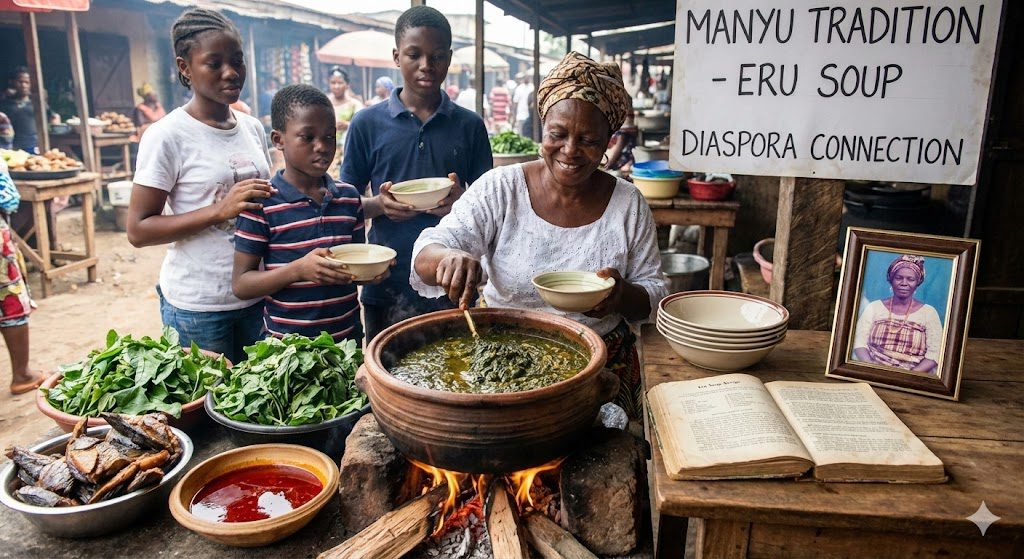
You cannot tell the story of Eru soup without telling the story of the Mami Eru—the market women who specialised in selling this dish.
In Manyu communities, particularly in market towns and trading posts, certain women became known for their Eru soup. They had their spots in the market. They had their regular customers. They had reputations. A Mami Eru wasn’t just a cook—she was a businesswoman, a community figure, a keeper of culinary knowledge, and often the economic backbone of her household.
These women didn’t have formal training. They had inherited knowledge. They learned from their mothers, who learned from their mothers. They understood the seasonal variations of Eru leaves. They knew which suppliers had the best quality. They could taste a soup and adjust it with her eyes closed. They could feed fifty people from market materials and make a profit. They could stretch ingredients during lean times and create abundance during plenty.
The Mami Eru was also a centre of community life. Her market stall was where gossip happened, where news spread, where young women learned not just cooking but how to navigate economy, society, and power. The knowledge she transferred wasn’t just culinary—it was strategic, social, political.
When Manyu families migrated to cities or to the diaspora, something was lost. The Mami Eru system couldn’t easily transplant to London, to Paris, to New York. There was no market stall. No established customer base. No seasonal rhythms that matched where they’d moved.
So diaspora Manyu women had to become their own Mami Eru—cooking for family, for community gatherings, keeping the knowledge alive in home kitchens instead of market stalls.
The Eru soup you eat today is the inheritance of those market women and the diaspora cooks who refused to let this knowledge disappear.
Eru Soup at Life’s Defining Moments
In Manyu culture, Eru soup appears at every significant moment:
At births: After a woman gives birth, her family ensures she has nourishing Eru soup. It’s considered healing food—warming, strengthening, restoring after the ordeal of labour.
At funerals: The quality and generosity of Eru soup served at a funeral is a statement about how the deceased was valued. A family’s economic and social standing can be read in the Eru soup they serve in mourning.
At celebrations: Weddings, naming ceremonies, achievements—Eru soup is always there, always central, always signalling abundance and respect.
At coming-of-age ceremonies: During initiation rites like Nkim, young women ate Eru soup as part of their transition into adulthood. The act of being served the family’s special Eru soup was acknowledgment: you are now a woman. You are part of this community’s continuity.
In daily life: Every family meal, especially on special occasions or when guests arrive. The default way to show respect, abundance, and care is through Eru soup.
What this means: Eru soup isn’t just food. It’s a language. When you serve it, you’re communicating status, care, cultural identity, respect for family, connection to history.
When you make it the traditional way, you’re speaking that language fluently.
The Science: Nutritional Value & Health Benefits
Why Your Ancestors Were Right (The Nutritional Truth)
Your grandmother didn’t have access to modern nutritional science. She couldn’t read about bioavailability or macronutrient profiles. Yet when she made Eru soup—combining leafy greens, palm oil, protein, and traditional spices—she was creating one of the most nutritionally complete dishes in African cuisine.
Modern nutritional science confirms what your ancestors knew through centuries of observation: Eru soup is extraordinarily nutrient-dense.
The Leafy Green: Gnetum Africanum
The Eru leaves themselves are nutritional powerhouses:
Protein Content: Eru leaves contain approximately 25-30% protein by dry weight. That’s as much protein as many legumes. In communities where meat was expensive and not always available, Eru leaves provided essential amino acids for building and maintaining muscle tissue.
Vitamins & Minerals: Eru is rich in:
- Vitamin A (as beta-carotene) – Essential for eye health, immune function, and skin health
- Vitamin C – Boosts immunity, aids iron absorption, supports collagen formation
- Calcium – For bone health (particularly crucial for women at all life stages)
- Iron – Critical for women of reproductive age, especially in communities where anaemia was common
- Magnesium – For muscle and nerve function, energy production
- Potassium – For heart health and blood pressure regulation
- Phosphorus – Works with calcium for bone strength
Fibre Content: Substantial dietary fibre supports digestive health, feeds beneficial gut bacteria, and aids nutrient absorption.
Bioactive Compounds: Eru contains polyphenols and other antioxidants that protect cells from damage and reduce inflammation.
What’s remarkable: Eru leaves maintain much of their nutritional value even after cooking, because traditional Manyu preparation methods—gentle simmering rather than aggressive boiling—preserve heat-sensitive nutrients.
The Palm Oil Component
Palm oil gets a bad press in modern nutrition discourse, but within the context of traditional Manyu cooking, it plays a specific nutritional role:
Carotenoids: Palm oil is extraordinarily rich in beta-carotene (precursor to vitamin A) and other carotenoids. It’s one of the richest natural sources. When combined with Eru leaves (which also contain vitamin A precursors), the effect is synergistic—fat-soluble vitamins are better absorbed in the presence of fat.
Vitamin E: Natural tocopherols in palm oil provide antioxidant protection.
Energy: In communities where physical labour was the norm and caloric needs were high, the energy density of palm oil was necessary for sustenance.
Absorption Enhancement: The fat in palm oil helps absorb fat-soluble vitamins A, D, E, and K from the Eru leaves and any vegetables included in the soup.
The modern controversy around palm oil centres on industrial monoculture plantations and their environmental impact. But traditionally sourced, small-scale palm oil production—which is what your ancestors used and what diaspora communities should seek out—is a legitimate part of healthy African cuisine.
The Protein: Meat, Fish, and Umami
Traditional Eru soup includes meat (beef, mutton, or occasionally bush meat) or fish, providing:
Complete Protein: All nine essential amino acids needed by the body.
Micronutrients: Meat provides bioavailable iron, zinc, B vitamins, and selenium—nutrients that are harder to absorb from plant sources alone.
Umami: The savoury depth that makes Eru soup deeply satisfying comes partly from glutamates and nucleotides in meat and fish. This satisfaction signal helps regulate appetite and makes the dish more nourishing on a psychological level as well as nutritional.
Collagen & Gelatin: Slow-simmered bones and connective tissue release collagen, which supports joint health, skin health, and gut barrier function. Your ancestors weren’t thinking about “gut health” as a concept, but they were creating the conditions for it.
The Spices: Medicine in Every Pinch
Traditional Manyu Eru soup includes spices—often ground crayfish, sometimes local peppers, sometimes other seasonings—that serve both flavour and medicinal functions:
Crayfish: Adds umami and provides minerals (calcium from the exoskeleton, omega-3 fatty acids).
Black Pepper: Contains piperine, which enhances nutrient absorption and has anti-inflammatory properties.
Other Traditional Seasonings: Various additions across regions provide antimicrobial and anti-inflammatory benefits.
The Complete Picture: A Functional Food
When you combine all these elements—Eru leaves, palm oil, protein, spices—you create a dish that is:
- Nutrient-dense: Every spoonful delivers vitamins, minerals, protein, and beneficial compounds
- Bioavailable: The components work together to help your body absorb and utilise the nutrients
- Satiating: The combination of protein, fat, and fibre makes you feel full and satisfied
- Anti-inflammatory: The combination of compounds helps reduce chronic inflammation
- Supportive of energy: Sufficient calories plus sustained-release carbohydrates from the broth
- Gut-healthy: Fibre, collagen, and pre-digested nutrients support microbiome health
Your ancestors didn’t need modern nutrition science to understand this. They experienced it. A family eating Eru soup regularly was a healthy family. Pregnant women fed Eru soup had better pregnancies. Nursing mothers who ate Eru soup had abundant milk. Children who grew up eating Eru soup developed strong bodies.
Science has now confirmed what centuries of observation already knew: Eru soup is functional medicine disguised as comfort food.
Traditional Preparation Methods: The Recipe
Before You Begin: Sourcing Your Ingredients
The quality of your Eru soup depends entirely on ingredient quality. Unlike many dishes where substitutions work, Eru soup requires authentic ingredients to taste right and deliver the nutritional benefits.
Eru Leaves:
- Fresh Eru (if you have access to it during season or through specialty suppliers) is ideal
- Dried Eru (available from African/Cameroon shops, online suppliers) works well and is often easier to source in the UK
- Do not substitute with spinach, kale, or other greens—the flavour and cultural significance change entirely
- Suppliers: African specialist shops, online Cameroon/West African food suppliers, some Asian grocers stock it
Palm Oil:
- Unrefined, virgin palm oil—the red/orange colour is important; it indicates it hasn’t been chemically processed
- It should have a slightly sweet, earthy aroma
- Look for suppliers that source responsibly from small-scale producers in Cameroon or Nigeria
- Poor quality or refined palm oil lacks the flavour and nutritional benefits
Meat:
- Beef (chuck steak, ribs, or bone-in cuts) is most traditional
- Can also use mutton, goat meat, or fish
- Look for good quality from butchers, ideally with some bone and connective tissue for flavour and collagen
- Avoid boneless, lean cuts—the flavour comes from fat and bone
Crayfish:
- Dried ground crayfish (powder) is traditional
- Look for bright orange-red colour and fresh smell
- Available from African shops and online suppliers
Additional Seasonings:
- Salt (to taste)
- Ground black pepper (optional but traditional)
- Local peppers or chilli (optional, depends on regional variation)
- Stock cubes (Maggi or similar—traditional in Cameroon, though controversial; optional)
The Step-by-Step Recipe: Traditional Method
Prep Time: 20 minutes Cook Time: 90 minutes Serves: 6-8 people
Step 1: Prepare the Meat (15 minutes)
- If using fresh Eru leaves (not dried), wash thoroughly and set aside. If using dried Eru, measure out approximately 300g dried leaves (which rehydrates to roughly 1.5kg fresh equivalent).
- Cut meat into medium chunks (about 4-5cm pieces). Don’t remove all the fat—it carries flavour.
- Place meat in a large pot of cold water. Bring to a boil.
- Once boiling, remove the meat with a slotted spoon, discard the water (this removes impurities), and rinse the meat under cold water.
- Return the cleaned meat to the pot with fresh cold water (approximately 1.5 litres). Bring to a simmer.
- Add salt and any seasoning cubes if using. Simmer for 30-40 minutes until the meat is tender and the broth is flavourful.
Why this matters: Pre-boiling removes impurities and creates a cleaner, clearer broth. The second boil infuses the broth with meat flavour, which becomes the base of your soup.
Step 2: Prepare the Eru (If Using Dried)
- Measure dried Eru leaves—typically 300g for 6-8 servings.
- Place in a bowl and cover with warm water. Let soak for 5-10 minutes until softened.
- Gently separate the leaves (they’ll be clumped together when dried).
- Rinse under cold water to remove any debris.
- Set aside until ready to add to the pot.
Note: If using fresh Eru, simply wash thoroughly and set aside. Some cooks prefer to blanch fresh Eru briefly before adding, but this is optional.
Step 3: Prepare the Palm Oil Base (10 minutes)
- Heat the palm oil in a separate, heavy-bottomed pot over medium heat (not high—palm oil can smoke if overheated).
- Once warm, add finely chopped onions (1 medium onion is typical) and sauté gently for 2-3 minutes until translucent.
- Add ground crayfish (3-4 tablespoons typically, adjust to taste) and stir well. The crayfish will bloom in the hot oil, releasing its flavour.
- Add black pepper to taste (approximately 1 teaspoon, but adjust based on preference).
- If you’re adding fresh peppers, finely chop them and add now. Traditional recipes might include a pinch of chilli or hot pepper for depth.
- Stir well—this mixture is your flavour base. Smell it. It should be rich and aromatic.
Why this matters: Blooming the spices and crayfish in hot oil releases their flavour compounds and distributes them throughout the oil. This is why your soup tastes like “nothing” if you skip this step—the flavours aren’t activated.
Step 4: Combine & Build (60 minutes total)
- Carefully add the flavoured palm oil mixture to the pot with the meat and broth. Stir well.
- The mixture should look visibly red/orange. Taste the broth—it should be distinctly flavoured, salty enough that it’s tasty (but not so salty you can’t taste the other flavours).
- Bring to a gentle simmer.
- Now add the Eru leaves (fresh or rehydrated dried). Stir gently to distribute.
- Simmer for 30-40 minutes. The soup will gradually thicken as the Eru releases its starches and breaks down slightly.
- Stir occasionally (every 10 minutes or so) to ensure even cooking and to prevent sticking at the bottom.
- The soup is ready when:
- The Eru is fully softened but not mushy
- The broth is thick enough that a spoon stands up in it but it’s still pourable
- The flavour is balanced—not too salty, with all elements clearly tasting (meat, leafy green, crayfish umami, palm oil richness)
Consistency Guide:
- Too thin? Let it simmer longer—more of the water will evaporate and the Eru will continue releasing thickening starches.
- Too thick? Add a little warm broth or water, small amounts at a time.
- Too salty? You can’t fix this, so better to under-salt and let people add to taste.
- Not flavourful enough? Check if the palm oil properly bloomed and the crayfish is well-distributed. If made correctly, the flavour builds as it simmers.
Step 5: Final Adjustments (5 minutes)
- Taste once more. Adjust seasoning as needed.
- Some cooks prefer a bit more heat (pepper)—add now if desired.
- Some add a squeeze of lemon juice for brightness (optional, not traditional but modern variation).
- Serve hot in bowls.
Traditional Serving:
- Serve in bowls as part of a meal with fufu, pounded yam, rice, or plantains
- The Eru soup is the centrepiece; the starch is supplementary
- Eat by tearing off pieces of fufu and dipping them into the soup, or mixing the soup with rice
Timing & Make-Ahead Notes
Can you make it ahead? Yes. Eru soup often tastes better the next day, as flavours meld. Refrigerate in an airtight container for up to 3 days.
Can you freeze it? Yes, though the texture of the Eru leaves changes slightly when frozen and thawed. For best results, freeze without the Eru leaves, then add fresh (or rehydrated) Eru when reheating. It will keep frozen for up to 3 months.
Reheating: Gently reheat on the stovetop over low-to-medium heat, stirring occasionally. Add a splash of water if it’s too thick. Do not microwave if possible—gentle heat maintains texture better.
Regional Variations: How Eru Soup Differs Across Manyu Territory
Cameroon Manyu Version (The Home Standard)
The traditional Eru soup from Manyu Division in Cameroon is:
Characteristics:
- Rich and thick, almost stew-like
- Generous with meat and palm oil
- Heavily spiced with ground crayfish
- Often includes additional groundnuts or peanut powder for extra richness and protein
- Some families add a small amount of smoked fish for extra umami
- Served as the centrepiece of a meal, not a side
Preparation Differences:
- May use more palm oil than diaspora versions (oil is cheaper in Cameroon; abundance is a sign of respect)
- Likely includes a range of wild spices and herbs that aren’t available elsewhere—creating a flavour profile unique to that region
- Often simmered for longer than the base recipe (up to 2 hours), which creates a deeper, more integrated flavour
When You Taste It: You’re tasting the closest thing to what your ancestors ate. The flavour is complex, rich, and slightly overwhelming if you’re not used to it. This is intentional.
Nigeria Yoruba/Igbo Variation (The Close Cousin)
In Nigeria, similar soups exist—called afang in Igbo regions and okazi in some Yoruba areas. Related but distinctly different:
Differences from Cameroon Manyu Version:
- Often includes more vegetables (okra, pumpkin leaves, spinach as supplements)
- May use more spices and local peppers
- Sometimes includes more seafood (shrimp, crab) instead of meat
- Flavour profile is slightly different—sometimes more fiery with peppers, sometimes more complex with additional herbs
Why It Matters: The Manyu/Cameroon and Nigerian versions represent slightly different culinary traditions, though they share the same foundation. If you’re Manyu and learning about heritage cooking, the Cameroon version is your direct lineage. The Nigerian versions are interesting cultural cousins—similar enough to be recognisable, different enough to be distinctly their own.
Diaspora Versions (The Adaptation)
In the diaspora, Manyu cooks have adapted Eru soup to available ingredients and modern constraints:
Typical Adaptations:
- Less palm oil: Not always affordable or available in large quantities; also modern health concerns make some cooks reduce the amount
- More accessible proteins: Chicken instead of mutton; canned fish instead of fresh; sometimes no meat at all for vegetarian versions
- Supplementary greens: Some cooks add spinach or kale to stretch the Eru (not traditional, but practical)
- Modern seasonings: Some diaspora cooks use modern stock cubes more liberally than traditional cooks would
- Faster cooking time: Modern pots and heat sources mean it cooks faster than over a traditional fire
- Occasional substitutions: Some use olive oil if palm oil isn’t available (not recommended—the flavour is completely different, but it happens)
The Diaspora Question: Is diaspora Eru soup “authentic” if it’s made with adaptations?
The answer is yes—with important caveats.
Authenticity isn’t about following a recipe exactly. It’s about maintaining the spirit of the dish. If you’re using genuine Eru leaves, real palm oil, and the traditional preparation method, but using chicken instead of beef because that’s what you can afford, your soup is authentic. You’re adapting to your circumstances the way your ancestors adapted to theirs.
What matters is that you’re not abandoning the core—the Eru leaves, the palm oil, the method. Those are non-negotiable if you want real Eru soup.
The adaptations that matter least: specific meat type, exact amounts, modern additions like lemon juice. The adaptations that matter most: using actual Eru leaves (not substitutes), using real palm oil, using the proper cooking method.
How to Make Diaspora Versions
Vegetarian Version (for dietary restrictions):
- Omit meat entirely
- Use vegetable stock instead of meat broth
- Cook the palm oil base as normal
- Add more protein through added beans, groundnuts, or crayfish
- Result: still nutritious, still delicious, still authentic in method if not in tradition
Budget Version (when ingredients are scarce or expensive):
- Use less meat but keep some for flavour
- Stretch with supplementary greens (spinach works, though it changes the flavour slightly)
- Use proper Eru and palm oil (these are non-negotiable for authenticity)
- Cook longer to extract maximum flavour from the base ingredients
- Result: thinner than traditional, but the method and core are maintained
Quick Weeknight Version:
- Use pre-cut meat from butcher
- Reduce simmering time by using pressure cooker (if you own one) for the meat stage
- Use high-quality stock cubes instead of making stock from scratch
- Keep everything else traditional
- Result: tastes quite close to traditional with about 50% less cooking time
The Stories: Mami Eru & The Market Women Who Fed Communities
Who Was the Mami Eru?
If you grew up in a Manyu community, you knew her. Every market had one—the woman whose Eru soup was legendary. The woman whose regular customers would arrive at specific times, knowing her pot would be ready. The woman who could taste a soup once and recreate it perfectly. The woman who made enough income from her Eru soup to support her household.
She wasn’t formally trained. She had no certificates or qualifications. Yet she was more skilled than any professional chef—because she had to be. Her livelihood depended on it. Her reputation depended on consistency. Her family’s food security depended on her ability to make something delicious and nutritious from market ingredients.
The typical Mami Eru:
Woke before dawn to source her ingredients—visiting suppliers she’d known for years, knowing which vendor had the best quality Eru that morning, which had decent meat, which had crayfish that wasn’t stale.
Arrived at her market spot by 8 or 9 AM with everything she needed—ingredients, her large cooking pot, firewood or charcoal, bowls for serving.
Spent the morning preparing: chopping, blooming spices, building her flavour base, starting the long simmer that would develop the soup’s character.
By midday the soup was ready—thick, fragrant, calling customers from across the market. People could smell her Eru from metres away.
Served all afternoon: portions to regular customers who arrived at the same time every day, to new customers who’d heard about her, to schoolchildren with pocket money, to labourers on their break, to families buying for dinner.
Earned enough to pay for the day’s ingredients, make a profit, feed her own family, save a bit for her children’s school fees or household needs.
Cleaned up by evening and repeated the next day, and the next day, and the next day—for years, sometimes decades.
The Knowledge She Carried
A Mami Eru wasn’t just a cook. She was a repository of knowledge:
Culinary Knowledge:
- How to adjust seasoning based on the quality of that day’s ingredients
- How to stretch ingredients during lean months without sacrificing quality
- How to achieve the perfect consistency every time
- How to manage heat to prevent burning while maintaining slow cook
- How to know when meat is perfectly tender without checking constantly
- How to layer flavours so that the soup is complex but balanced
Agricultural Knowledge:
- When Eru was in season and at its best
- Which suppliers had the best quality
- How to store Eru and know when it was going bad
- Which regions produced better Eru at different times of year
- How seasonal variations affected the soup’s flavour
Economic Knowledge:
- How to price her soup competitively but profitably
- How to manage costs and maintain margins
- How to build customer loyalty so she had reliable income
- How to navigate market politics and supplier relationships
- How to save and invest her earnings
Community Knowledge:
- Who needed food on credit and could be trusted to pay later
- Who was pregnant and needed extra nourishing food
- Who was grieving and needed comfort
- Who was celebrating and needed abundance
- How to use her market position to support and sustain her community
Health Knowledge:
- Which Eru was especially nourishing for pregnant women
- How Eru soup aided healing and recovery
- What adjustments helped different health conditions
- How the food itself was medicine
When Mami Eru Migrated
What happened when Mami Eru migrated to the UK? To France? To America?
She couldn’t set up a market stall. Markets in Western countries didn’t work that way. There was no informal food economy where you could cook from a pot and sell portions to passing customers. There were health codes and regulations and liability and licensing.
So the Mami Eru became invisible.
She went from being a respected community figure—a businesswoman, a knowledge keeper, the heart of the market—to being just “someone who cooks for family.”
Yet she kept making her Eru soup. She made it for community gatherings. She made it for church events. She made it when people asked her to teach them. She made it for family celebrations. She made it because not making it would mean losing something essential.
The diaspora Mami Eru isn’t a businesswoman anymore. She’s a cultural custodian.
And her work—unpaid, unrecognised, done in home kitchens instead of market stalls—is what has kept Eru soup alive in diaspora communities.
The Mami Eru Stories: Keeping Memory Alive
Every Manyu diaspora family has a Mami Eru story. Often it’s the grandmother or mother who made Eru soup that tasted like home. It’s the woman who taught younger generations. It’s the knowledge keeper.
These stories matter because they connect us to a lineage of women who chose to maintain their culture despite migration, despite displacement, despite pressure to assimilate.
When your mother makes Eru soup the way her mother made it, she’s not just cooking. She’s saying: I remember. I carry this forward. My children will know where they come from.
That’s why Eru soup is more than food. It’s love. It’s memory. It’s resistance. It’s continuity.
How to Source Ingredients in the UK: A Practical Guide
Finding Authentic Ingredients (It’s Easier Than You Think)
The beauty of living in the UK with a diverse diaspora population is that you can find almost everything you need—if you know where to look.
Eru Leaves:
Fresh (Seasonal):
- Specialty African markets in major cities (London, Manchester, Birmingham have excellent options)
- West African/Cameroon-specific shops
- Some Turkish or Middle Eastern shops also stock similar greens
- Best time: June-September when in season
Dried (Year-Round):
- Virtually all African specialist shops carry dried Eru
- Online suppliers: Many Cameroon/West African food shops ship to UK
- Amazon UK: Search “dried Eru” or “gnetum africanum”—multiple sellers available
- Cost: Usually £3-6 for a bag that makes several pots of soup
Palm Oil:
Best Sources:
- African specialist shops (non-negotiable—must be unrefined, virgin palm oil)
- Caribbean shops (also stock high-quality palm oil for their cuisine)
- Some Asian shops (though quality varies)
- Online: Specialist suppliers, some with focus on sustainability
What to Look For:
- Unrefined (red/orange colour)
- Virgin (first cold-pressed)
- Label should indicate origin (ideally Cameroon or Nigeria)
- Some sellers specify “fair trade” or “small-scale producer sourced”—these are preferable for ethics and flavour
- Cost: Usually £3-8 for a 500ml bottle, though prices vary with sourcing ethics
Red Flags:
- Clear/pale yellow colour = refined (chemically processed, wrong for Eru soup)
- “Cooking oil” without specificity = possibly not what you want
- Suspiciously cheap = probably not quality
Meat:
Best Sources:
- Local butchers (specify what you want; good butchers take pride in helping customers choose)
- Halal butchers often have good quality meat and understand slow-cooking traditions
- Supermarkets (acceptable but less ideal—you have less choice in cut and quality)
What to Ask For:
- “Meat on the bone, with some fat” for maximum flavour
- Beef chuck steak, beef ribs, or bone-in beef stew meat
- Let the butcher know you’re making a slow-cooked soup—they’ll recommend appropriate cuts
- Many butchers will give you meat trimmings/bones cheaply or free if you ask
Crayfish (Ground):
Best Sources:
- African specialist shops (essential for authentic taste)
- Some Caribbean shops
- Online suppliers
- Cost: Usually £2-4 for a small container
Alternative:
- Whole dried prawns/shrimp (slightly different flavour but acceptable)
- Ground in a coffee grinder or food processor at home for fresher taste
Building Your Suppliers List
Don’t just buy once—build relationships with shops that stock what you need.
Step 1: Find Your Local African Shop
- Search online: “[Your city] + African shop” or “Cameroon shop near me”
- Ask in local community groups or churches
- Many towns with significant diaspora populations have at least one
Step 2: Visit & Ask
- Go in person when possible
- Tell them what you’re looking for (Eru soup ingredients)
- Ask if they stock what you need; if not, ask if they can source it
- Many shop owners will order specific items if asked
- Build a relationship—regulars get better prices and first pick of stock
Step 3: Online Backup
- Identify 2-3 reliable online suppliers for items you can’t find locally
- Compare prices and shipping costs
- Many online sellers offer better prices if you buy larger quantities
- Some offer subscription boxes of African staples
Step 4: Quality Check
- First time buying from a new source, buy small quantities
- Test the quality before committing to larger purchases
- If something isn’t right (palm oil smells off, Eru leaves are mouldy), don’t use it—complain to the seller
Cost-Saving Tips
Authentic Eru soup doesn’t have to break the bank.
Buy in bulk: If you’re making it regularly, buy larger quantities of Eru and palm oil. Prices are much better per unit. Dried Eru lasts months if stored properly.
Build a regular order: Many online sellers offer discounts for regular customers or larger orders. If you commit to ordering every month, ask about discounts.
Community buying: Organise with other Manyu families to buy together. Pool your orders, split bulk costs. Community members can collectively buy quantities that individuals wouldn’t.
Use what’s economical: Beef chuck is often cheaper than fancier cuts and actually makes better soup (more connective tissue = more flavour). Work with your butcher to find the best value.
Make large batches: Make enough for several servings, freeze it. You’re spreading the preparation effort and ingredient costs across multiple meals.
The Nutritional Breakdown: What You’re Actually Eating
Per-Serving Analysis
A typical serving of Eru soup (approximately 300-400ml, including meat and broth):
Calories: 250-350 kcal (depending on palm oil amount and meat content)
Protein: 25-30g (excellent—roughly equivalent to a chicken breast)
Fat: 15-20g (primarily from palm oil and meat; includes beneficial fats)
Carbohydrates: 10-15g (primarily from starches in Eru leaves and any root vegetables)
Fibre: 3-5g (from Eru leaves; aids digestion and gut health)
Key Micronutrients (per serving):
- Vitamin A: 40-60% of daily recommended intake
- Vitamin C: 25-35% of daily recommended intake
- Calcium: 15-20% of daily recommended intake
- Iron: 30-40% of daily recommended intake (higher if made with red meat)
- Magnesium: 20-25% of daily recommended intake
- Potassium: 15-20% of daily recommended intake
- Zinc: 20-30% of daily recommended intake
Glycemic Index: Low (the soup causes a slow, steady rise in blood sugar, not a spike)
Inflammatory Profile: Anti-inflammatory (the combination of antioxidants, omega-3s if using fish, and phytochemicals from Eru leaves provides net anti-inflammatory effect)
What This Means for Your Health
One serving of Eru soup provides:
- Protein for muscle maintenance and repair
- Iron and vitamin C combination (vitamin C enhances iron absorption) – particularly important for women at risk of anaemia
- Calcium and magnesium – bone health, muscle function, nervous system health
- Antioxidants – protection against oxidative stress and chronic disease
- Fibre – digestive health, stable blood sugar, beneficial microbiome
- Healthy fat (when made with quality palm oil) – hormone production, brain health, nutrient absorption
The Traditional Wisdom Confirmed:
Your ancestors knew Eru soup was nourishing. They observed that:
- Pregnant women eating Eru soup had easier pregnancies and better milk supply
- Nursing mothers needed regular Eru soup to maintain energy and nutrition
- Children who ate Eru soup grew strong and healthy
- Families eating Eru soup regularly were healthier overall
Modern nutrition science confirms: they were right. Eru soup is one of the most nutritionally complete dishes in African cuisine. A person eating regular Eru soup with adequate calories from starches would have excellent nutrition.
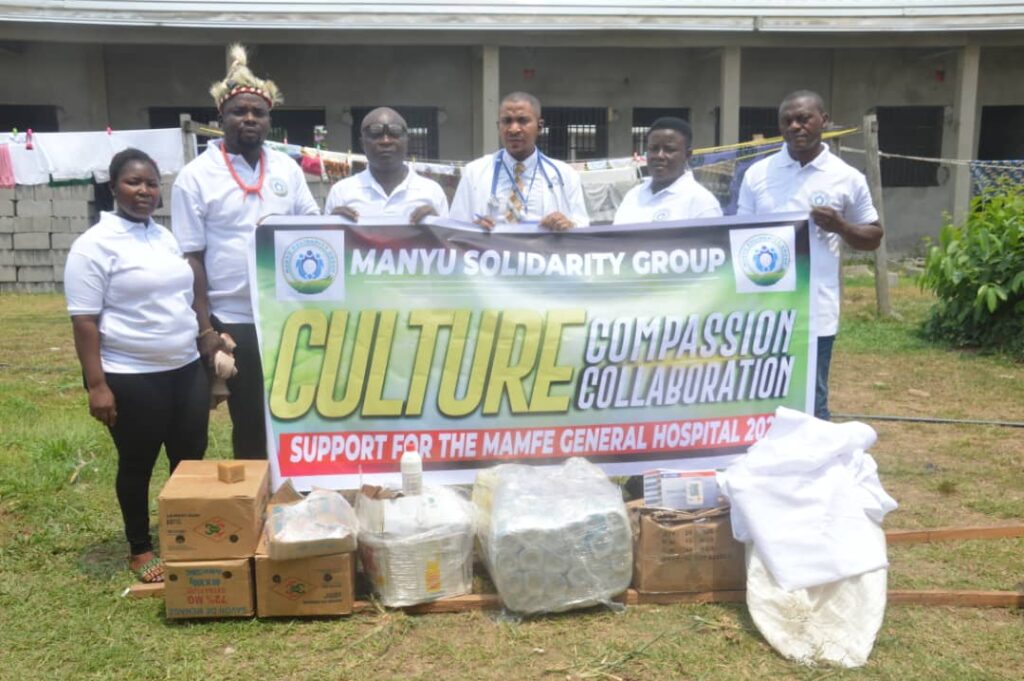
Making This Real: What Manyu Solidarity Group Offers
Membership Benefits for Food & Cooking
If you’re reading this thinking “I want to learn to make authentic Eru soup” or “I want to teach my children” or “I want to connect with others who value this food”—that’s exactly why membership in Manyu Solidarity Group UK exists.
As a member, you get access to:
Cooking Workshops & Classes
- Live or recorded demonstrations of Eru soup preparation
- Learn from experienced cooks who grew up making this dish
- Small-group settings where you can ask specific questions
- Advanced techniques and regional variations
- Seasonal workshops when fresh Eru is available
Recipe Collection & Resources
- Access to member-curated recipes for Eru soup and related dishes
- Written recipes, video tutorials, and step-by-step guides
- Variations from different Manyu families (how their grandmother made it)
- Troubleshooting guides (soup too thin? too salty? here’s what to do)
- Nutritional information and meal-planning guidance
Ingredient Sourcing Network
- Member directory of trusted suppliers across the UK
- Where to find authentic Eru, palm oil, and other ingredients
- Group buying opportunities (bulk order together, share costs)
- Supplier reviews and recommendations
- Seasonal alerts (fresh Eru available now; crayfish price increase coming)
Community Connection
- Meet other Manyu families who value traditional cooking
- Share recipes and cooking tips
- Ask for help when you can’t find ingredients
- Celebrate when you make your first Eru soup
- Stories from community members about why this food matters to them
Cultural Context
- Understand the history and significance of this dish
- Learn the stories of market women and food traditions
- Connect cooking to broader cultural preservation
- Teach your children why this food is important, not just how to cook it
- Access to written materials on food’s role in Manyu identity
Connection to Knowledge Keepers
- Access to experienced cooks and cultural teachers
- Mentorship for learning traditional cooking methods
- Questions answered by people who grew up with this food
- Guidance on adapting recipes for your circumstances while maintaining authenticity
Why Membership Matters for Cooking Traditions
Food traditions don’t survive by accident. They survive because people actively choose to maintain them. You can learn Eru soup from YouTube, but there’s something different about learning it from your community—people who understand why it matters, not just how to make it.
Membership in Manyu Solidarity Group means joining a community that has collectively decided: this food matters. This knowledge matters. We’re going to keep it alive.
When you’re part of that community, you’re not alone in the work of preservation. You have support, encouragement, and practical help.
The Video Component: Bringing Eru Soup to Life
Video Content Ideas (For Our YouTube/Social Media Strategy)
This blog post is enhanced by video content showing:
Full Recipe Tutorial (15 minutes)
- Shot in real kitchen (not fancy studio)
- Actual Manyu woman cooking Eru soup her way
- Shows each step clearly
- Includes tasting and adjustment moments
- Subtitled for accessibility
Traditional vs. Quick Version (10 minutes)
- Side-by-side comparison
- Shows what changes and what stays the same
- Demonstrates both methods have value
Where to Find Ingredients (8 minutes)
- Tour of local African shop
- Interviews with shop owners
- Where to buy online
- Cost breakdown
Stories of Mami Eru (20 minutes documentary)
- Interviews with women about their market food experience
- Historical photographs if available
- Diaspora cooks sharing how they maintain traditions
Nutritional Deep-Dive (10 minutes)
- Nutritionist explaining benefits
- Breaking down what each ingredient contributes
- Why palm oil matters
- Why Eru is superior to substitutes
From Around the World (15 minutes)
- How Manyu version differs from Nigerian afang
- Other West African soup traditions
- Bringing them together
FAQ: Common Questions About Eru Soup
Q: Can I use spinach or kale instead of Eru?
A: Technically yes, but you’re making a different dish. Spinach and kale have completely different flavour profiles, nutritional concentrations, and cultural significance. The soup won’t taste like Eru soup—it will taste like “leafy green soup.” If you’re making Eru soup, use actual Eru. If you can’t find Eru and need a leafy green soup, spinach works, but be honest with yourself that it’s not the authentic dish.
Q: Is palm oil really healthy despite what the internet says?
A: Palm oil in the context of traditional African cuisine, used in traditional portions, is perfectly healthy. The modern criticism centres on industrial palm oil production (environmental destruction, labour exploitation) and modern overconsumption in processed foods. Neither applies to small-batch, traditionally sourced palm oil used in traditional dishes. Your ancestors thrived eating Eru soup with palm oil. The nutritional science confirms it’s a healthy food when prepared traditionally.
Q: How do I know if my Eru is fresh enough?
A: Fresh Eru should smell green and earthy, not musty or sour. Look should be green (not brown or black). When you cook it, it should soften and turn a darker, more muted green—but maintain some texture (not turn to mush). If it smells off, don’t use it. If it’s slimy or visibly mouldy, discard it. When in doubt, ask the shop keeper—they can tell you how old the Eru is.
Q: Why does my Eru soup never taste like my mother’s?
A: Most likely: you’re not using the same ratio of ingredients, or you’re not letting it simmer long enough. Your mother built her recipe through years of muscle memory and practice—she knows exactly how much crayfish to use, how long to simmer for that particular brand of Eru, how to adjust for the specific water in her kitchen. Start with the basic recipe in this article, but then adjust based on taste. Ask your mother specifically: “How much crayfish do you use?” “How long do you let it simmer?” “Do you add anything else?” Get specifics, not just “to taste.”
Q: Can I make Eru soup in a pressure cooker?
A: Yes, though some cooks argue the flavour develops better with slow simmering. If using a pressure cooker, reduce the liquid by about 25% (pressure cooking reduces evaporation), and reduce cooking time to about 20-30 minutes total (less time for traditional simmering). The result is acceptable but slightly less complex than traditional method.
Q: My family speaks a different Manyu language—does this recipe still apply?
A: The basic principles apply to all Manyu language groups—Ejagham, Kenyang, Denya, etc. The dish may have slight variations between language groups, but the core (Gnetum africanum leaf, palm oil, slow cooking) is consistent. Ask your family’s specific variation and adapt from there.
Q: Is it okay to add groundnuts or other vegetables?
A: Regional variations do include groundnuts (peanut powder) and sometimes other vegetables. If your family’s version includes these, add them. If not, stick to the core recipe. Adding these is a modification, not traditional across all regions, but not wrong—just different.
Q: How do I teach my children to make Eru soup?
A: Start young (age 5-6) by having them watch and help with small tasks (stirring, smelling ingredients, tasting). By age 10-12, they can do more (chopping, managing heat with supervision). By 16+, they can make it independently. The key is repetition and explanation—not just “do this,” but “this is why we do it this way, this is what your great-grandmother did, this is why it matters.” Make it a ritual, not a chore.
Q: What if I’m allergic to palm oil?
A: Eru soup without palm oil is a completely different dish and loses much of its character. There’s no satisfying substitute (olive oil, coconut oil, vegetable oil—none deliver the same result). If you have a palm oil allergy, you might need to skip Eru soup, or consult with your doctor about whether a small amount in a traditionally prepared dish would be tolerable. This is a health question—follow medical advice.
Q: Can Eru soup be vegan?
A: With modifications. Use vegetable stock instead of meat broth, omit meat, and potentially add more protein through beans, lentils, or extra crayfish powder. It will be nutritious but won’t taste like traditional Eru soup, which centres meat flavour. It’s a modification for dietary reasons, which is perfectly valid—just don’t call it traditional Eru soup.
The Bottom Line: Why Eru Soup Matters Now
Here’s what happens when you learn to make Eru soup:
You’re not just cooking. You’re practising an act of cultural continuity. You’re saying: My people created knowledge systems, agricultural traditions, and culinary arts that sustained them for centuries. I choose to maintain that knowledge.
You’re not just feeding yourself. You’re feeding your family food that’s nourished your lineage for generations. You’re creating neural pathways in your children’s brains—they smell Eru soup, they taste it, they help make it, they associate it with home and family. That becomes part of their identity, their sense of belonging.
You’re not just preparing a meal. You’re participating in an economy of care. The shop owner you buy from. The supplier who sources the Eru. The community members who gather to eat it. The connections that are maintained through shared food. The memory of market women who fed their communities. All of this is activated every time you make Eru soup.
You’re accessing wisdom. Your ancestors knew this food sustained them physically and spiritually. Modern nutrition science confirms they were right. When you eat Eru soup, you’re consuming knowledge encoded in the ingredients—knowledge about what the human body needs, gathered over centuries.
You’re resisting erasure. In a world that constantly tells you your culture is outdated, that traditional ways are inferior, that modern processed food is the future—Eru soup says: No. These ways are alive. They’re valuable. They’re worth maintaining.
Your grandmother made Eru soup in a world that told her to assimilate. Your mother made Eru soup in a world that told her to modernise. You can make Eru soup in a world that tells you to forget.
That’s revolutionary. That’s resistance. That’s love.
Take Action: From Reading to Cooking
This Week
- Find your supplier. Search online for “African shop near me” or “Cameroon food supplier UK.” Locate where you can buy Eru and palm oil.
- Buy your ingredients. Get small quantities to start: dried Eru, palm oil, meat from your butcher, ground crayfish. Total cost: approximately £15-20 for ingredients that make 6-8 servings.
- Read through the recipe in this article once, start to finish. Don’t cook yet—just familiarise yourself.
This Weekend
- Make your first Eru soup using the recipe in this article. Follow it step-by-step. Don’t stress about it being perfect.
- Take notes. Write down what you did, how long it took, how you adjusted it. These notes become your personal recipe.
- Taste it. Honestly assess: Is it too salty? Not salty enough? Does the flavour match what you remember? Make mental notes for next time.
- Eat it. Share it with family. Notice how people react. Notice how it makes you feel.
This Month
- Make it again. You’ll do better the second time. Your hands will remember the motions. Your palate will better understand the flavour target.
- Ask your family. Text or call an older family member. Tell them you made Eru soup. Ask them about their version. Get specifics: “How much crayfish did your mother use?” “Did she add anything special?”
- Join Manyu Solidarity Group UK if you haven’t already. Access to cooking workshops, recipe collections, and community connection with others doing this work.
- Teach someone. Even if you’ve only made it once, teach a family member or friend. Explain why it matters. Share the knowledge.
This Year
- You’ll make Eru soup regularly—it will become part of your family’s rhythm.
- You’ll have perfected your recipe to match your preferences and family tradition.
- You’ll have taught children or younger family members, passing the knowledge forward.
- You’ll be part of a community actively maintaining this tradition.
- You’ll have experienced how food is culture, how cooking is activism, how a single dish carries centuries of wisdom.
Closing: The Inheritance In Your Hands
Your ancestors created Eru soup. Not in a laboratory. Not from a recipe book. Through observation, experimentation, and accumulated wisdom about what the land provided and what the body needed.
They didn’t have nutritional science to tell them that palm oil and Eru leaves together create a synergistic nutritional powerhouse. They knew it because they lived it.
Your grandmother learned to make Eru soup from her mother. Not from a cookbook—from watching, helping, repetition, and intuition. She learned when to add crayfish, how long to let it simmer, when the consistency was right.
Your mother learned the same way. And now it’s your turn.
When you make Eru soup, you become part of an unbroken chain of knowledge that stretches back centuries. You join the Mami Eru market women. You join your grandmother. You join every Manyu woman who chose to maintain this tradition despite pressure to forget it.
That’s not just cooking. That’s revolution. That’s love. That’s how culture survives.
Your child deserves to taste Eru soup made by their parent who learned from their grandparent who learned from their grandmother. That continuity—that unbroken chain—is one of the greatest inheritances you can pass forward.
It starts with one pot. One recipe. One decision to maintain what matters.
Make Eru soup. Teach someone else. Keep it alive.
Join Our Community
Ready to deepen your knowledge of Manyu food traditions?
Manyu Solidarity Group membership gives you access to:
- Live cooking workshops featuring experienced Eru soup makers
- Recipe collection with variations from across Manyu communities
- Ingredient sourcing network and bulk buying opportunities
- Community connection with families maintaining food traditions
- Stories and cultural context about why this food matters