Mamfe – The Capital of Manyu

Woven through the Great Plains, descending into the Ossidinge depression, and anchored by the pristine shores of two rivers — the Badi and Manyu — the western river-port city of Mamfe serves as both the administrative and commercial nerve centre of Manyu Division.

Mamfe is arguably as multi-faceted and historical as any city in Cameroon. Its history is a jigsaw puzzle of disparate and sometimes turbulent epochs — economic, socio-cultural, political, and historical — that together form a rich historical tapestry. This strategic junction city sits at the crossroads of trade routes connecting Cameroon’s interior to Nigeria’s Cross River region, making it a vital hub for over a century.

Today, Mamfe remains the symbolic and administrative heart of the Manyu nation, connecting diaspora communities across the UK, Europe, and beyond to their ancestral homeland.

Woven through the Great Plains, descending into the Ossidinge depression, and anchored by the pristine shores of two rivers — the Badi and Manyu — the western river-port city of Mamfe serves as both the administrative and commercial nerve centre of Manyu Division.

Mamfe is arguably as multi-faceted and historical as any city in Cameroon. Its history is a jigsaw puzzle of disparate and sometimes turbulent epochs — economic, socio-cultural, political, and historical — that together form a rich historical tapestry. This strategic junction city sits at the crossroads of trade routes connecting Cameroon's interior to Nigeria's Cross River region, making it a vital hub for over a century.

Today, Mamfe remains the symbolic and administrative heart of the Manyu nation, connecting diaspora communities across the UK, Europe, and beyond to their ancestral homeland.

What's in the Name? The Origin of "Mamfe"

The origin of the name "Mamfe" has as many versions as there are languages in Manyu Division. The most popular legend tells a story of colonial-era linguistic misunderstanding that gave the town its name.

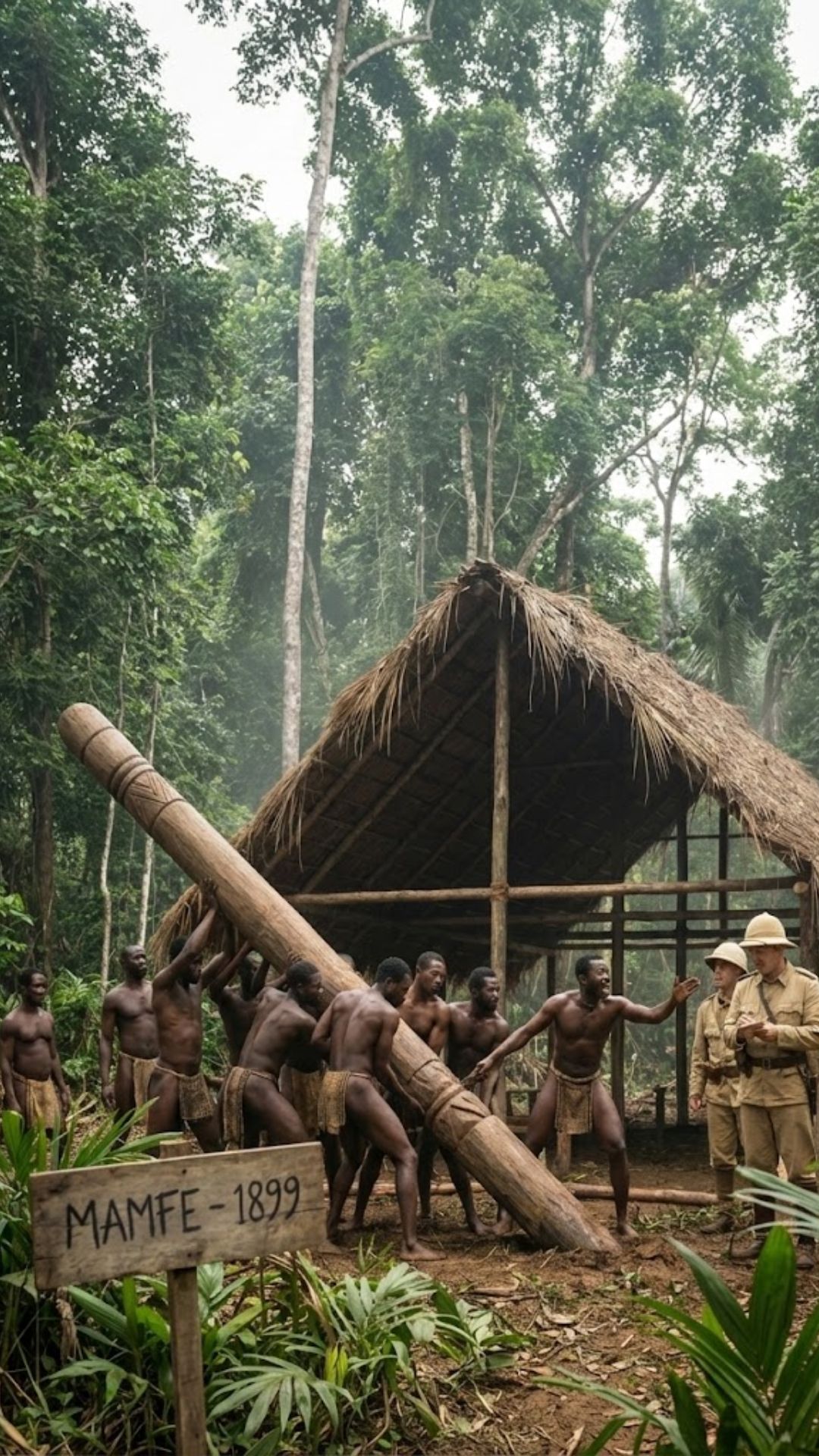
Mamfe in 1899

Mamfe circa 1899 — Early colonial period

The Legend of the Ekwap

Before Western contact, traditional Manyu houses were built with careful attention to status and spiritual significance. Prominent community leaders constructed homes with a large living room called Acha Eket or Etambu — a "meeting house" — containing an Ekwap, a ceremonial pole-support.

The ekwap was a stout pole running from floor to roof-tree, with earth packed into a conical shape at its base. At a small hole at the bottom (called nerekwap), ritual offerings were made to the dead. The erection of an ekwap marked its owner's leadership and spiritual authority within the community.

According to legend, when the Germans — led by Lieutenant V. Queis, station controller at Rio del Rey — arrived via the Grossfluss (Great River) in the late 1890s, they encountered builders lowering an ekwap into position. Unable to understand German (Deutsch), one builder urged his fellows to continue their work, saying "Mamfeah!" in the Kenyang language — meaning "let's put it in."

The Germans apparently misunderstood this command as the answer to their question about the town's name, and thus "Mamfe" was born — a name originating from colonial-era miscommunication that has endured for over a century.

Note: The building of traditional houses remains a communal endeavour in Manyu to this day.

Early Colonial Contact and German Administration

First European Contact (1888)

The first recorded entry into Manyu by a European occurred in July 1888, when Count Eugen von Zintgraff with his Monrovian followers travelled northwards from his station at Lake Barombi in Kumba to carry out reconnaissance for future expeditions.

Before Western intrusion, Manyu people had sophisticated indigenous systems well-adjusted to their way of life. The arrival of German traders in the 1890s, followed by military expeditions, would fundamentally disrupt these systems.

Establishment of Colonial Administration (1901-1902)

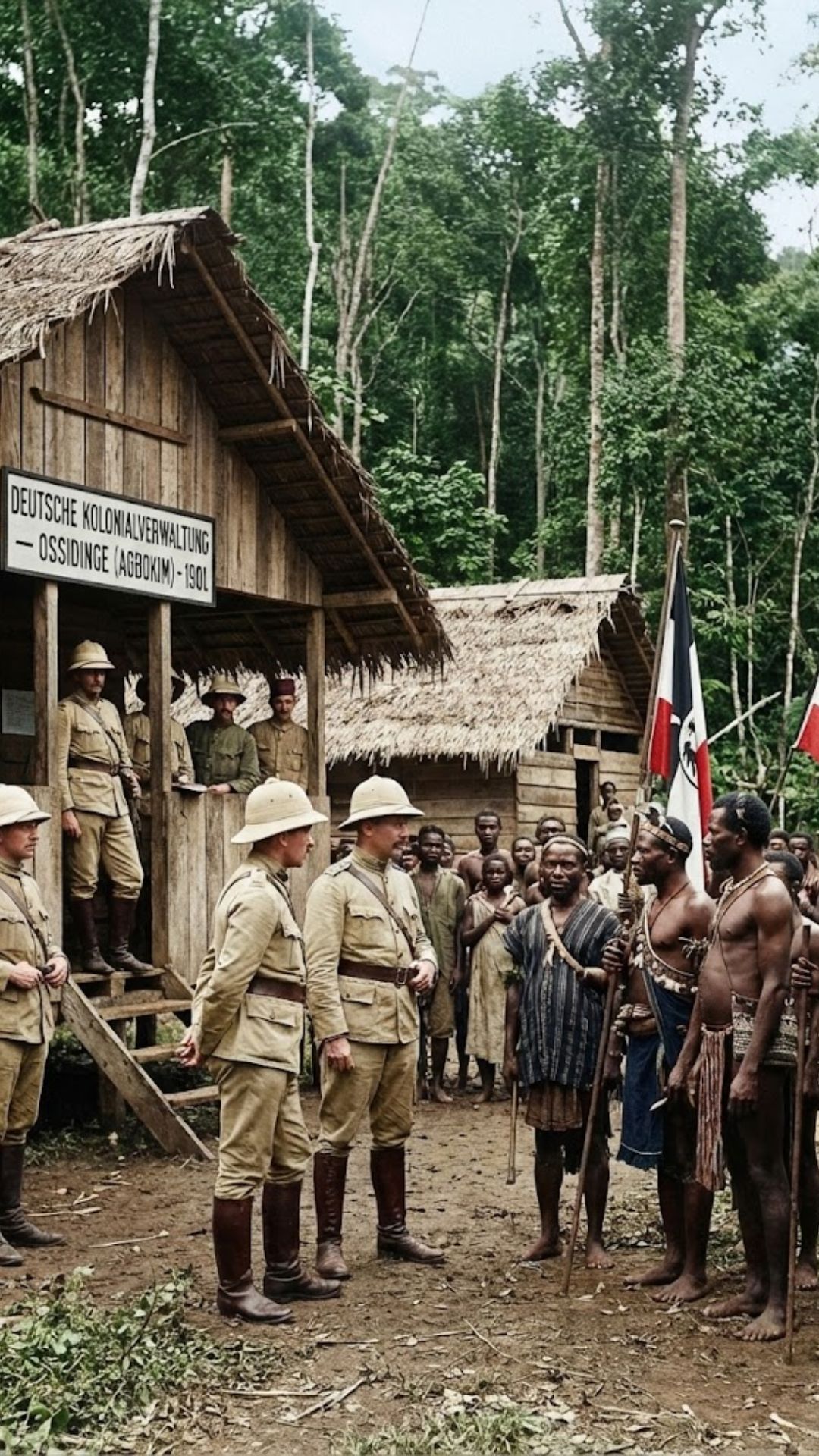
In the final decade of the 19th century, German traders began operating in Manyu, followed by military expeditions. It was not until 1901-1902 that the first civil administrative headquarters was established at Ossidinge (Agbokim) near the Cross River in eastern Ejagham territory.

In 1902, Count Puckler-Limburg became the first Civil Administrator, assuming responsibility for Ossidinge district — corresponding broadly to what later became Manyu Division.

First European Contact 1888

First European Contact (1888) — Count von Zintgraff's expedition into Manyu

Colonial Tensions and Resistance

Manyu people engaged in numerous political and military confrontations with the German colonial administration due to:

  • Lack of German understanding of cultural institutions and norms
  • Imposition of forced labour
  • Heavy-handed administration
  • Brute force used against the indigenous population

For Manyu people — whose entire social structure had operated for millennia without centralized state authority — subjection to a strong and ruthless colonial power fundamentally contradicted their psychological and cultural makeup. They had always loathed centralized authority.

Consequently, in 1904, Count Puckler-Limburg was killed while travelling in Anyang country on the "overside" of the Manyu River. His assassination would spark a major uprising.

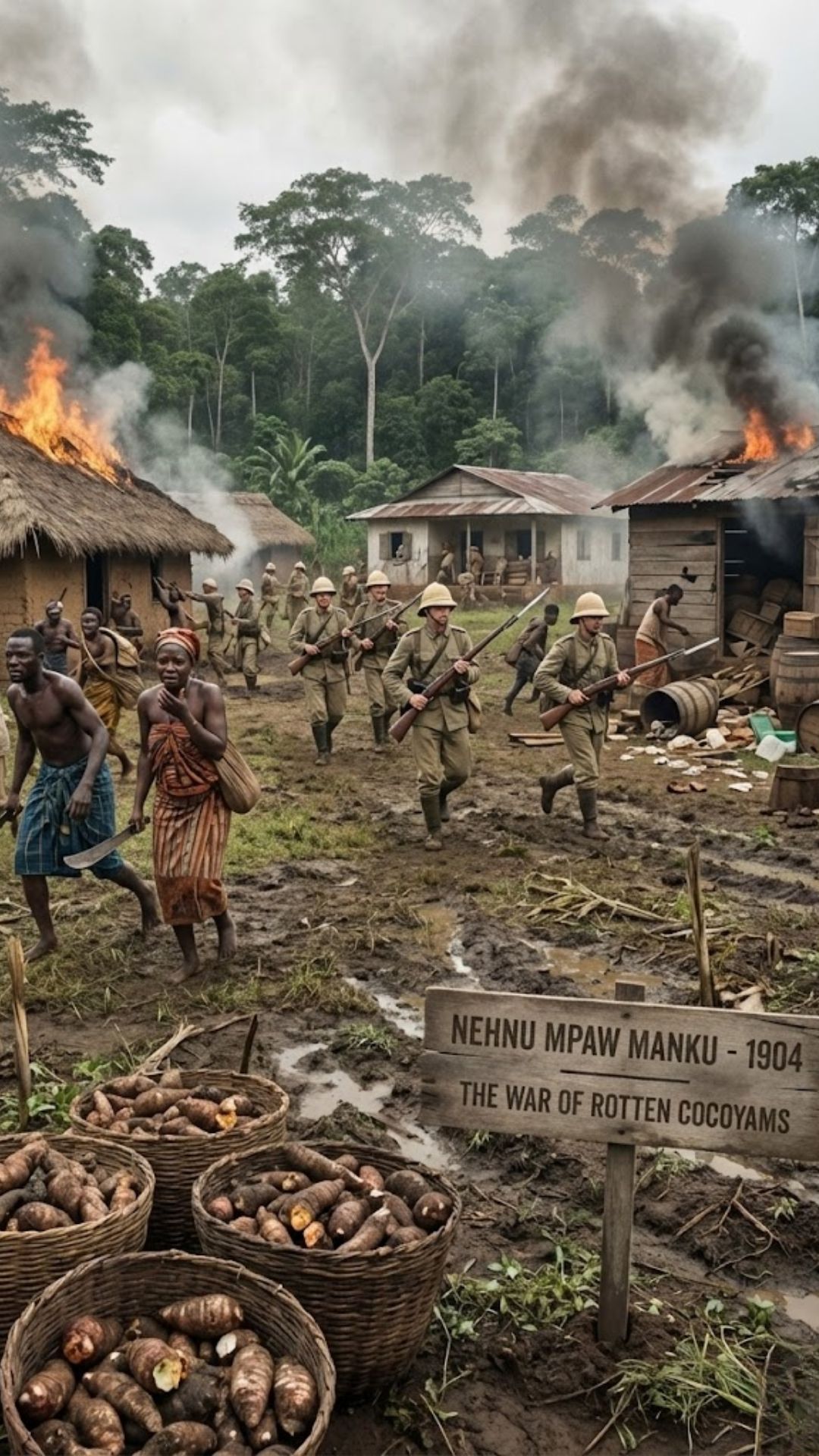
Nehnu Mpaw Manku: "The War of Rotten Cocoyams"

A defining moment of resistance against colonial oppression

Puckler-Limburg's assassination in 1904 sparked a widespread rebellion involving Anyang, Boki, Eastern Ejagham, and Lower Banyang villages. The uprising demonstrated the depth of resistance to colonial oppression.

War of Rotten Cocoyams

The Nehnu Mpaw Manku Rebellion (1904) — Manyu's fierce resistance to colonial rule

The Rebellion Unfolds

The violence spread rapidly:

  • Besongabang, Egbekaw, and Mamfe looted the German factory and John Holt warehouses in Mamfe
  • A number of trading stores were ransacked across the region
  • Five German traders on the Cross River were killed

The German agent Schmidt attempted to protect his factory but was forced to flee. When he returned to his house, he found his staff had abandoned him and taken his firearms. Meanwhile, looters discovered rum and gin in the warehouses.

Maddened by the unaccustomed alcohol, they hacked the unfortunate German to pieces with machetes as he attempted to escape by canoe.

The Aftermath

The subsequent chaos is still remembered in oral tradition:

  • Some people drank themselves to death
  • Others reportedly died after mistaking kerosene for gin in their intoxication

A German military expedition was dispatched from the south to pacify the area. Martial law and forced labour were imposed as collective punishment.

Warriors from frontline villages like Besongabang and Okoyong (Ayuk Etayak Clan) fled into the bush, only daring to emerge years later. The fleeing villagers abandoned their farms and failed to harvest their cocoyams. Most of the crop rotted in the fields.

This traumatic period was consequently christened "Nehnu Mpaw Manku" — the "War of Rotten Cocoyams" — a name capturing both the material devastation and the bitter memory of brutal colonial repression.

Mamfe alone offered sustained resistance and was practically decimated by German forces. The rebellion vividly illustrates the extent to which Manyu people refused to accept overarching central authority — a spirit of independence that persists to this day.

Dr. Mansfeld: A Different Kind of Administrator

Rebuilding After Devastation

When Dr. Alfred Mansfeld arrived after the Mpaw Manku war, he found Mamfe almost deserted and in ruins. Unlike his predecessor, Mansfeld approached his role with genuine curiosity and respect for Manyu culture.

Undaunted by the destruction, he not only performed his administrative duties but immersed himself in understanding how local people lived. He came to love and respect Manyu people on their own terms.

Documenting Manyu Culture

Mansfeld's fascinating book — the result of his insatiable curiosity — is filled with careful, objective observations on:

  • Architecture and housing
  • Trade and commerce
  • Warfare and conflict resolution
  • Slavery and social hierarchies
  • Handwork and craftsmanship
  • Religion and spiritual practices
  • Marriage, birth, and death customs
  • Health and traditional medicine
  • Justice and law
  • Music, dance, and storytelling

Though not a trained ethnologist, Mansfeld credited his insights to two friends: King Ogba from Mbenjan in Ejagham land and interpreter Odjong-Ofo, who patiently explained Manyu culture to him over three years. Mansfeld reported only what they told him.

His book is profusely illustrated with photographs, drawings, and maps, providing invaluable documentation of Manyu society in the early 20th century. The photographs show people who appear more as anthropological specimens than as fellow humans — a reflection of colonial-era attitudes — though the subjects apparently did not mind posing for the camera.

Dr. Mansfeld

Dr. Alfred Mansfeld — A colonial administrator who documented and respected Manyu culture

Mamfe Becomes the Capital (1909)

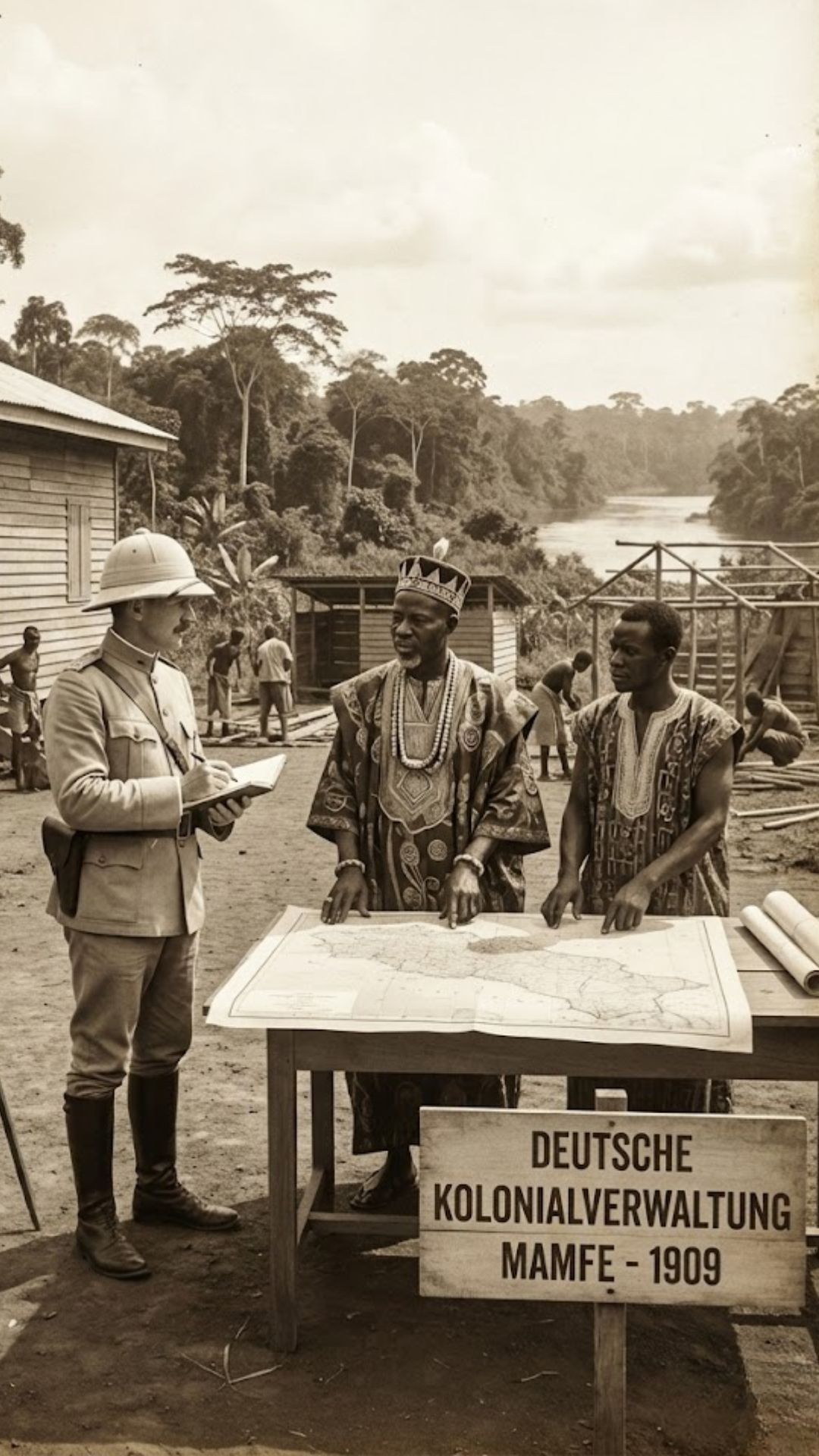
After succeeding Puckler-Limburg as the second Civil Administrator, Dr. Mansfeld changed the administrative headquarters to its present site in Mamfe in 1909 — establishing the town as the formal capital of Manyu Division.

Mansfeld remained in charge until the defeat of German forces at Nsanakang and Otu during World War I (1914-1916), after which the British took control of the region.

Mamfe as Political Crossroads: The 1959 Conference

By the early 1950s, Mamfe had become a hotbed of political activism, trade, and social interaction — at the forefront of Anglophone Cameroon's body politic.

The 1959 Phillipson Conference

In August 1959, Mamfe hosted a historic conference presided over by Sir Sydney Phillipson KBE, CMG, appointed by the British High Commissioner for Cameroons. His mandate was to report on the financial, economic, and administrative consequences of Southern Cameroons' separation from the Federation of Nigeria.

Representatives from both major political parties attended:

  • Kamerun National Congress (KNC) led by Dr. E.M.L. Endeley
  • Kamerun National Democratic Party (KNDP) led by John Ngu Foncha

The conference aimed to agree on questions for the forthcoming plebiscite determining Southern Cameroons' future.

The Plebiscite Questions Controversy

At the UN General Assembly's Trusteeship Council in September-October 1959, Foncha (KNDP) and Endeley (KNC) agreed that one plebiscite question should address association with Nigeria. However, they disagreed sharply on the second alternative:

Endeley's Position

"Separation from Nigeria and continued trusteeship until the Southern Cameroons was in a position to decide its future."

Foncha's Position

"Reunification with French Cameroons after the territory becomes independent on 1st January 1960."

Unable to reach agreement, the African delegation at the UN sought common ground. Liberia finally submitted a resolution proposing a plebiscite no later than March 1961 with two questions:

  1. Do you wish to achieve independence by joining an independent Federation of Nigeria?
  2. Do you wish to achieve independence by joining the independent Republic of Cameroon?

Notably, no option for independent statehood was offered — a source of enduring resentment among Anglophones who felt their right to self-determination was denied.

The Result is History

The 1961 Plebiscite — A pivotal moment in Cameroon's history

The Result is History

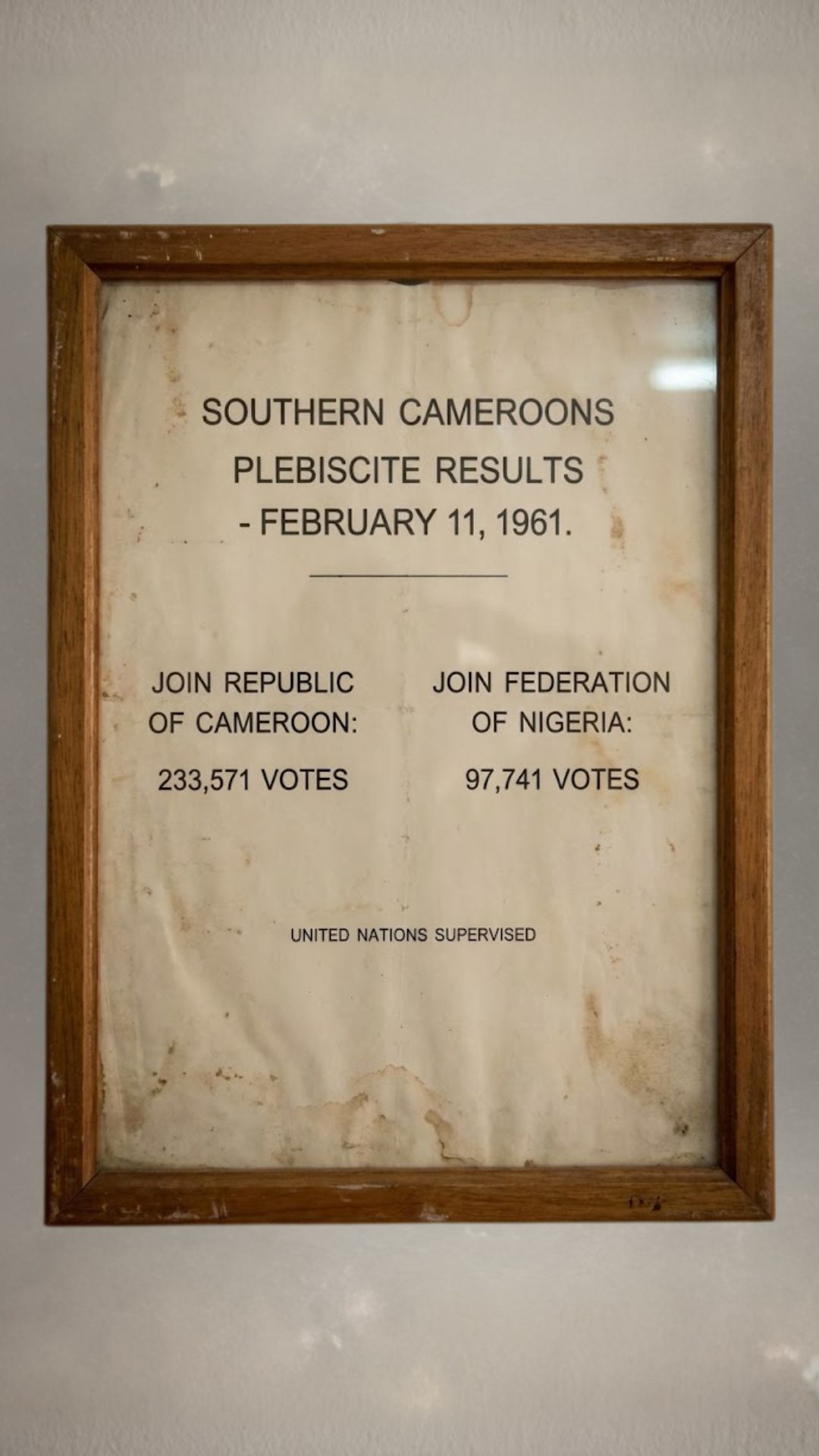
The plebiscite was held on February 11, 1961. Southern Cameroons voted 70.5% to join Cameroon, expecting a federal structure preserving autonomy. The subsequent abolition of federalism in 1972 and ongoing Anglophone marginalization have made Mamfe a focal point of contemporary political struggle.

Today, the ongoing armed conflict has seen Mamfe become a major flashpoint in the quest for the restoration of what separatists call "Ambazonia independence."

Geography and Climate

Geographic Setting

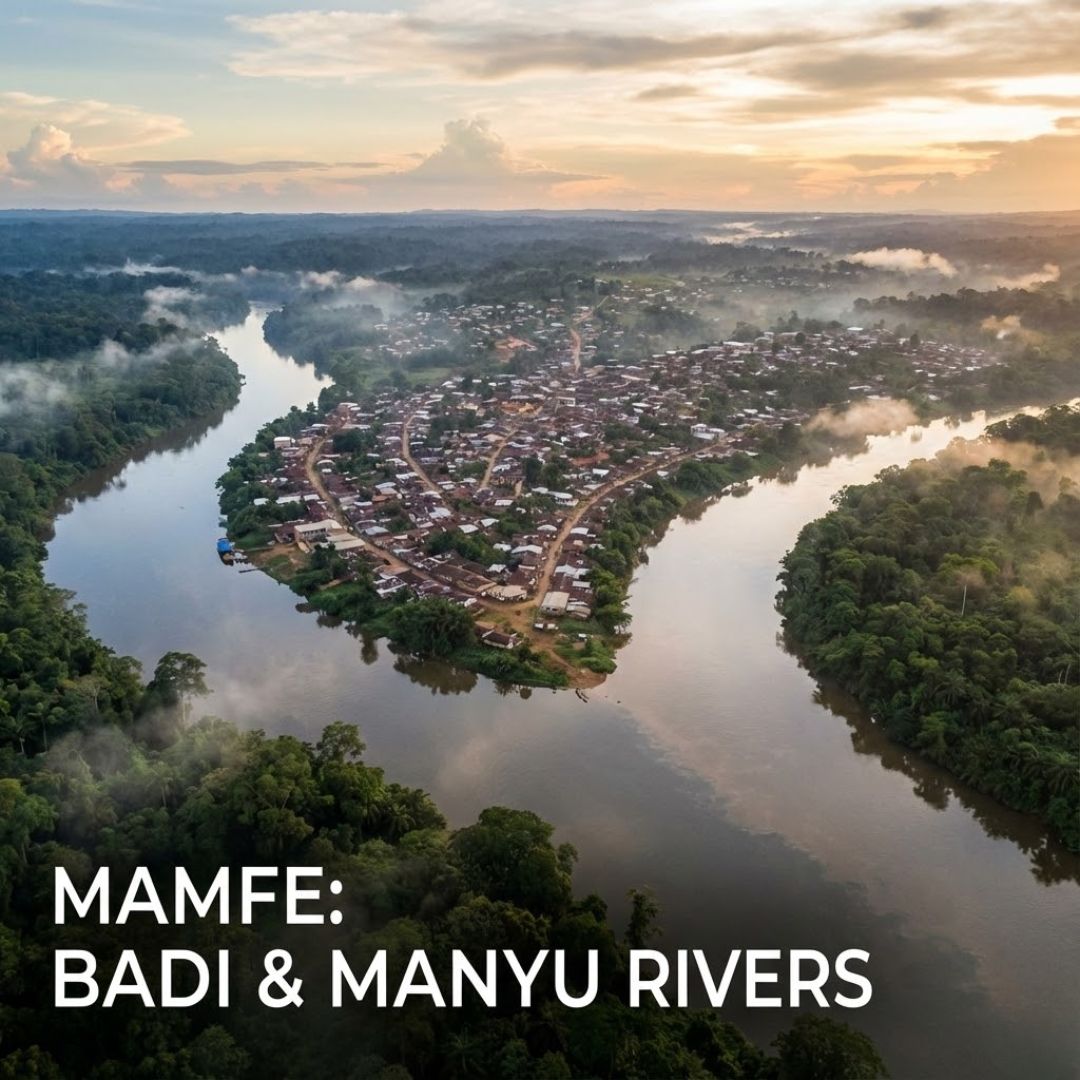
Mamfe sits at the confluence of the Badi and Manyu Rivers, creating a peninsula setting that has historically facilitated trade and transportation. The town lies approximately 74km from the Nigeria border at Ekok, making it a natural border town and commercial hub.

Climate

As Mamfe occupies a peninsula setting, the climate is characterized by:

  • High humidity: Can exceed 90% throughout the year
  • Dry season (February-April): Temperatures can exceed 120°F (49°C)
  • Rest of year: Temperatures remain in the 80-90°F (27-32°C) range
  • Rainy season: Temperatures sometimes fall to 60°F (16°C)

The climate is particularly welcoming for Western tourists escaping winter, offering warmth year-round.

Mamfe Rivers

The confluence of the Badi and Manyu Rivers — Mamfe's natural setting

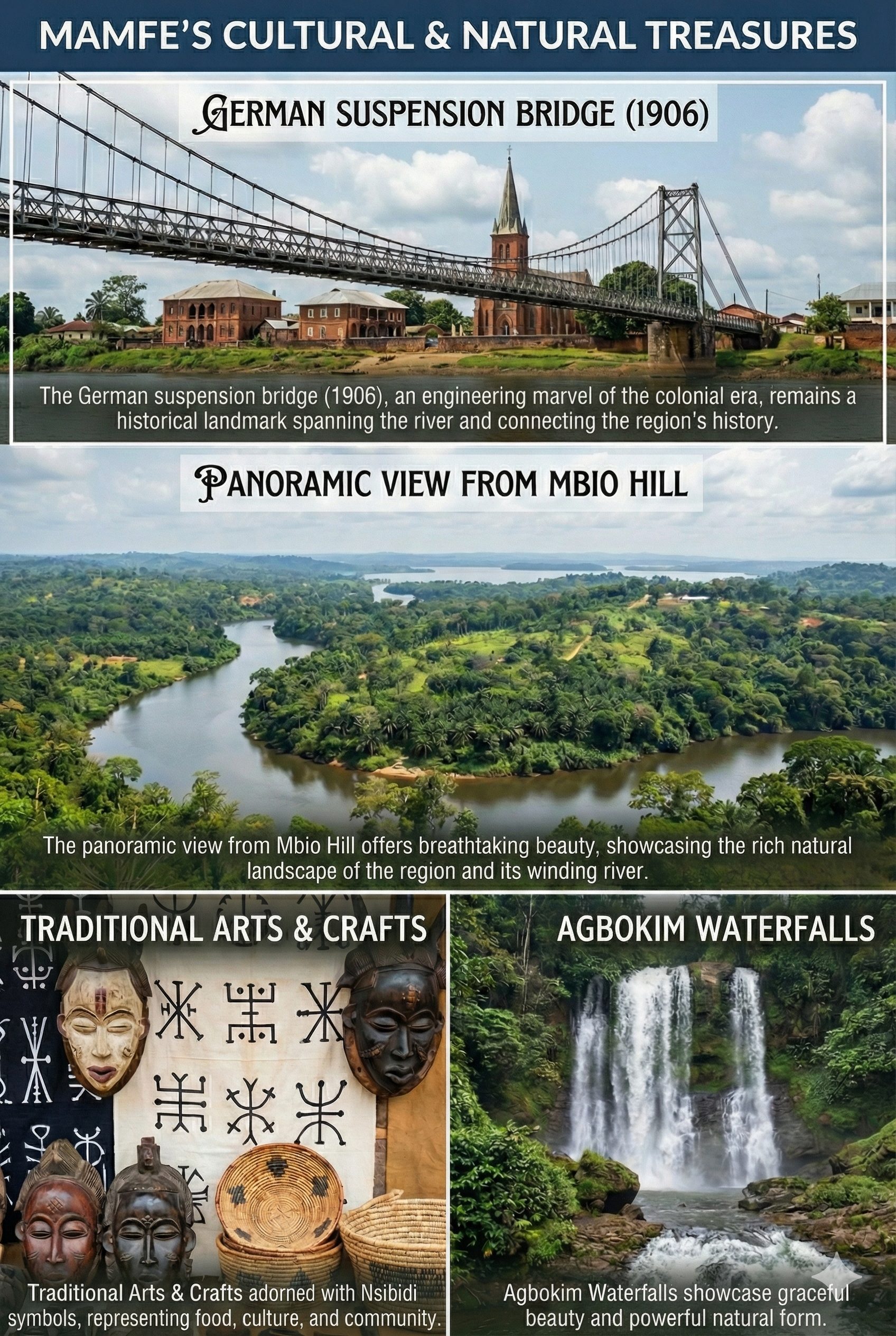
Mamfe's Cultural and Natural Treasures

A region rich in history, natural beauty, and cultural heritage

Despite ongoing security challenges, Mamfe and surrounding areas offer remarkable cultural and natural attractions:

Historic Landmarks

🌉

German Suspension Bridges (1906)

Two historic engineering marvels that continue to function over a century later

🏛️

German Architecture and Graves

Colonial-era buildings and cemeteries providing connections to the tumultuous early 20th century

⛪

Mamfe Cathedral

Prominent Catholic cathedral serving as both religious centre and architectural landmark

Natural Wonders

🌊

Manyu River

The river that gives the division its name, providing scenic beauty and historical significance

🏞️

Lake Ejagham

The spiritual epicentre of Ejagham civilization, considered sacred in traditional cosmology

⛰️

Mbio Hill

Offering panoramic views of Mamfe and surrounding countryside

💧

Agbokim Waterfalls

Spectacular natural waterfall near the Nigeria border featuring multiple cascades

Cultural Experiences

🎭

Traditional Art and Crafts

Distinctive Manyu crafts including skin-covered masks, Nsibidi artifacts, carved sculptures, and traditional instruments

🎉

Cultural Festivals and Ceremonies

When security permits, Mamfe hosts traditional celebrations, dances, and ceremonies

Important Safety Notice: Due to the ongoing Anglophone Crisis, tourism to Mamfe is currently restricted and potentially dangerous. Prospective visitors should consult current travel advisories before planning trips.

Mamfe Cultural Heritage

Mamfe's rich cultural and natural heritage continues to connect diaspora to homeland

Mamfe Today: The Heart of Manyu

Mamfe remains the administrative capital of Manyu Division and the symbolic heart of the Manyu nation. Though the ongoing conflict has devastated this once-thriving commercial and cultural hub, the town's history demonstrates remarkable resilience.

From surviving the brutal Nehnu Mpaw Manku rebellion, to serving as the political crossroads for Southern Cameroons' independence decisions, to enduring the contemporary Anglophone Crisis, Mamfe has weathered every storm in its turbulent history.

The capital of Manyu continues to serve as the heart connecting diaspora communities worldwide — including the Manyu Solidarity Group UK & Europe — to their ancestral homeland. When peace finally returns, Mamfe will rebuild, just as it did after 1904, after 1916, and after every crisis that came before.

Written by: Ekinneh Agbaw-Ebai
Updated and expanded by: Manyu Solidarity Group UK & Europe